Severity is a number. Reachability is a graph.
How I built Reachable for Graph Hacks: AI agents that rank security findings by what an attacker can actually reach, with FalkorDB doing the searching and the cutting.
Live: https://reachable.devarv.dev · Code: https://github.com/Atharv5873/reachable
TL;DR — In a synthetic company with 6,862 open vulnerability findings, only 14 lie on any path from the Internet to the data that matters. Reachable finds all of them, ranks a CVSS 7.5 above a 9.8 for a reason you can click on, and computes the smallest set of fixes that cuts every path (7 fixes for 9 paths), proven on a copy of the graph. Switch the graph off and the same AI agent finds 0% of the paths.
Most security teams triage the same way: export the scanner's findings, sort by CVSS, patch from the top. It feels rigorous. It's a number, NIST's vulnerability database publishes it, and a 9.8 is obviously worse than a 7.5.
Except it isn't, necessarily. CVSS describes a bug in a vacuum. What you actually care about is whether an attacker can get from the Internet, through your machines, keys and roles, to the data that would end up in a breach notice. That isn't a property of one node. It's a property of paths. And once you say "paths", you're talking about a graph.
So for Graph Hacks I built Reachable. It puts a company's infrastructure into FalkorDB, derives every possible attacker step as an edge, and has agents find the real attack paths and the smallest set of fixes that cuts all of them.
The moment that makes the point
In the demo org there are 6,862 open findings, and 3,525 of them score 9.0 or higher. Only 14 lie on any path from the Internet to a crown-jewel data store.
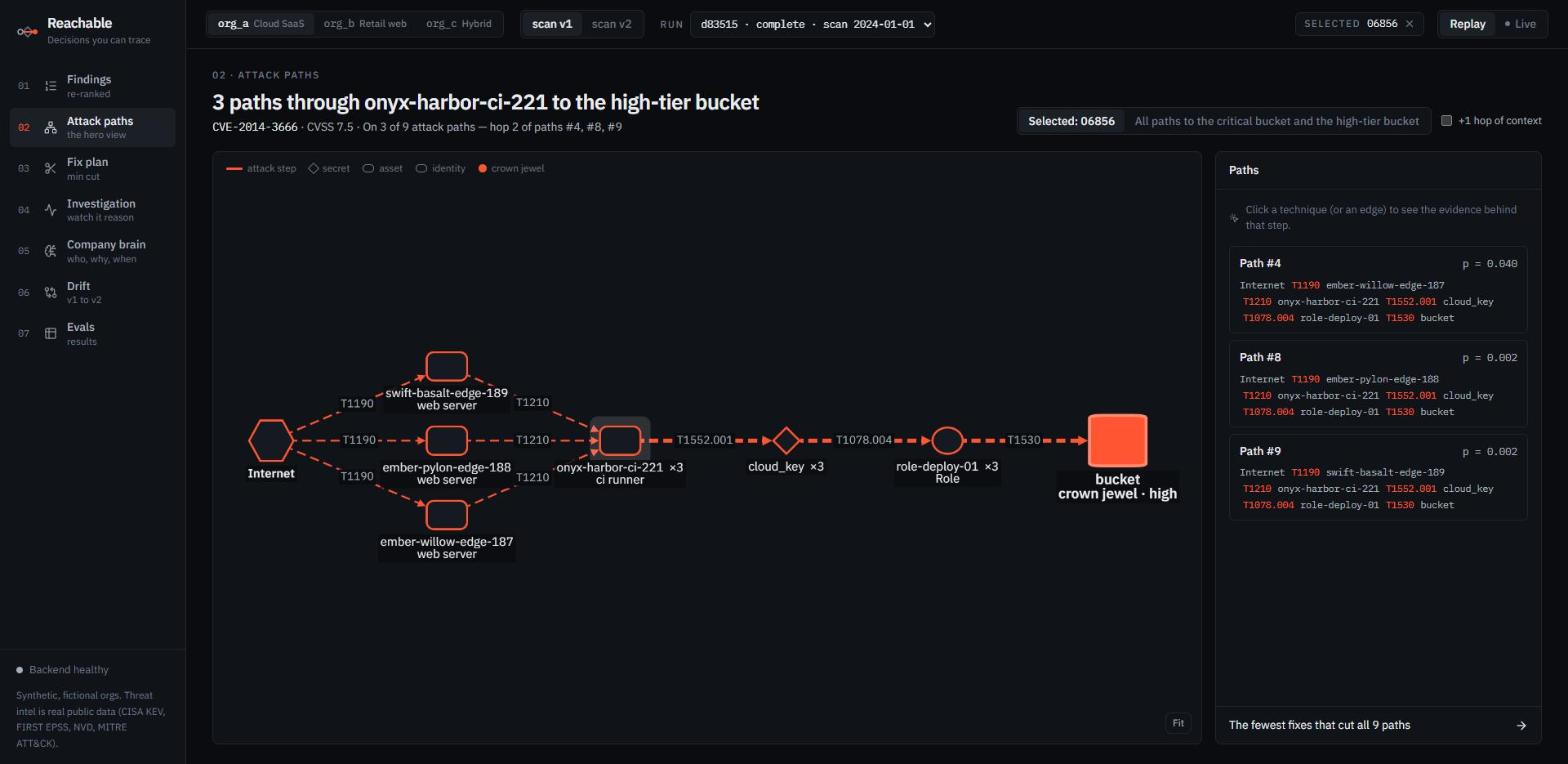
Reachable's number one is a CVSS 7.5 that the scanner ranks #4,175. It's on an internal CI runner. Three different Internet-facing web servers can each reach that runner by exploiting this one bug, and the runner holds a cloud key that can read the deploy bucket. Three attack paths, one bug: patch it and all three close.
Better still, the same 9.8 Ghostcat CVE appears at scanner ranks #1,487 and #1,488. One copy, on an edge web server, starts an attack path. The other sits in a quarantine zone that nothing leads to. Same CVE, same score, opposite answers. A severity sort can't tell them apart. A graph can't confuse them.
The data model: make the attacker's moves first-class
The core decision was to materialise attacker steps as edges instead of computing reachability on the fly in application code.
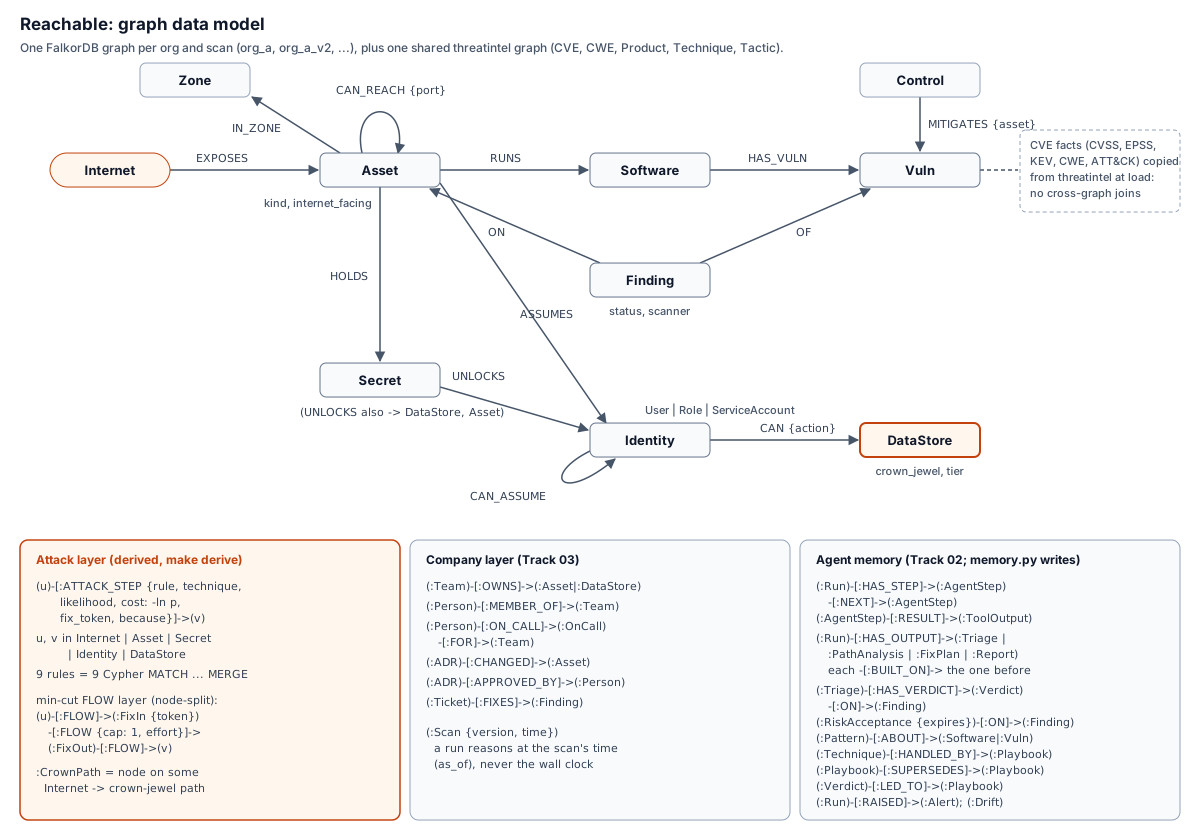
The raw graph is what a scanner and a cloud inventory tell you: Asset -[:CAN_REACH {port}]-> Asset, Asset -[:RUNS]-> Software -[:HAS_VULN]-> Vuln, Finding -[:ON]-> Asset, Asset -[:HOLDS]-> Secret -[:UNLOCKS]-> ..., plus identities, roles, data stores and mitigating controls. Next to it sits real public threat intelligence: CISA KEV, FIRST EPSS, NIST NVD and MITRE ATT&CK.
Nine attack rules, written as ten Cypher MATCH ... MERGE queries, turn those facts into ATTACK_STEP edges: "an attacker on A can exploit finding F to land on B". Each edge carries the ATT&CK technique, a likelihood, the fix_token that would remove the step, and because, the ids of the facts that justify it. Every hop on screen can show its evidence.
Two small choices made everything downstream fall out of FalkorDB's built-in algorithms:
cost = −ln(likelihood). Probabilities multiply along a path; negative logs add. So the shortest path under
algo.SPpathsis the most likely attack path. No custom search code.A node-split flow layer. Every fix token becomes a
FixIn -[:FLOW {cap: 1}]-> FixOutgate, and each step routes through its token's gate. Runalgo.maxFlowfrom the Internet to the crown jewels and the max-flow value is the minimum number of fixes that disconnects them (the max-flow/min-cut theorem).algo.maxFlowreturns flows, not the cut, so the cut is recovered from the residual graph, and the tool refuses to answer unless the cut's size equals the max flow. Swap capacity 1 for an effort score and the same algorithm returns the cheapest fix set instead.
Before any fix set is recommended, simulate_fix does a GRAPH.COPY to a scratch graph, deletes the fixed steps, and re-runs the path search. The UI's "Simulate" button is that check, live: both crown jewels flip from REACHABLE to SAFE.
Each tenant (and each rescan) is its own graph, with the company layer (teams, on-call, decision records, tickets) and the agents' memory right next to the infrastructure. That's what lets a fix plan say not just "patch this", but "Edge & Ingress owns it, Avrel is on call, and ADR-001 opened this port in 2022 — here's who approved it."
The agents, briefly
Four LLM agents (Triage, Pathfinder, Fixer, Reporter), plus a Sentinel for rescans that uses no LLM at all, run in a LangGraph pipeline. They pick their tools over MCP, never call each other, and hand off through a Run node in the graph. Every tool call is recorded with the Cypher it ran, and that trace is what the UI streams live and replays.
Memory lives in the graph too: verdicts carry over to the next scan, accepted risks expire, learned patterns flag new hosts on arrival, and an analyst's correction becomes a new playbook version. On the rescan, memory cut the work from 9 findings investigated to 1, and from 28 tool calls to 16, with the same verified fix set.
Does the graph actually earn its place?
The hackathon rules say it plainly: if the product still works without FalkorDB, the graph is decoration. So I built the eval to answer exactly that.
An independent networkx oracle, which never touches FalkorDB, computes the ground truth from the generator's raw data. Then the same findings are ranked five ways: CVSS; a "smart" score (CVSS + EPSS + KEV + Internet exposure); a vector-RAG agent and a SQL agent, both with the same LLM, prompt and budget as Reachable; and Reachable. Six scans, three of them held out.
| prioritiser | attack-path recall@10 | decoys@10 | paths cut per fix |
|---|---|---|---|
| CVSS sort | 0% | 0% | 0.00 |
| smart score | 0% | 33% | 0.00 |
| vector RAG | 0% | 0% | 0.00 |
| SQL agent | 10% | 11% | 0.30 |
| Reachable | 100% | 0% | 1.16 (= the oracle's min cut) |
The smart score is my favourite failure: it puts a decoy in every top 10 — an exposed, exploitable host that leads nowhere. Exposure is a property of one node. Reachability is a property of paths.
And the ablation: the exact same agent, same model, same prompt, with every graph tool answering "unavailable". Path recall drops from 100% to 0%. The graph supplies the answer; the model doesn't.
War story 1: my best metric was my weakest evidence
Halfway through, a ranking change took NDCG@10 from 0.82 to 1.00. A perfect score. I should have been thrilled; instead it bothered me, for two reasons.
First, it was saturated. Every org had one crown jewel, so the ground truth's priority was basically "how many paths does this finding lie on": 13 of the 14 relevant findings tied. NDCG only rewards putting higher relevance above lower, so any order of those 13 was "ideal". The metric had stopped measuring ranking quality.
Second, and worse, it was circular. My ranker and my ground truth define importance the same way: weighted reachability to the crown jewels. They're computed independently (the oracle in networkx over raw data, the ranker in FalkorDB at runtime with no access to labels, and a leakage test enforces that), so 1.00 does prove the derivation is right. But it isn't a discovery, and a judge would be right to say so.
What I did about it:
gave the crown jewels sensitivity tiers (customer data critical, deploy secrets high, logs medium), so the ground truth has a real gradient. The paths and min cut stayed identical, and a test pins the old fingerprints. A tier-blind version of my ranker now scores 0.95, so 1.00 means the gradient is actually handled;
led with structural metrics instead: path recall, decoys, paths cut per fix. You can't score well on those by sharing a definition; you can't cover nine paths without finding them;
kept the held-out rescans honest: they score the same as the development scans;
walled the tier off from the baselines, and the leakage test checks every column, prompt and RAG document they can see;
printed the caveat right next to the NDCG table, in the repo and in the UI.
And when the SQL agent did better on the re-run (10% path recall, up from 4%, by writing SQL that walked two hops back from the crown jewels — partial reachability by hand), that went in the report as-is.
War story 2: a CSRF hole in a security tool
The UI never holds the API key. The browser calls /api/r/* on its own origin, and a server-side Next.js route handler adds the key and forwards the request. Clean — until an automated security review of the first cut pointed out what I'd missed: a proxy that adds a credential to whatever reaches it is a confused deputy. Any other site open in the same browser could form-post to /api/r/runs and start billed agent runs on my key.
The fix is small and worth knowing. A POST must be application/json (a cross-site HTML form can't send that, and a cross-site fetch with it triggers a CORS preflight the route never approves) and must be same-origin (Sec-Fetch-Site: same-origin, or an Origin whose host matches). Everything else gets a 403 before the backend is ever called. On the live site: cross-site POST 403, text/plain POST 403, same-origin POST 200, off-allowlist path 404.
Shipping a CSRF bug in a tool whose whole pitch is "think like an attacker" would have been a special kind of embarrassing.
What I learned
Put the domain logic in the database, not around it. Once attacker steps were edges, shortest paths, max-flow and betweenness did the hard work in milliseconds, and every answer came with its evidence.
Build the answer key before the product. A second, independent implementation (networkx) turned "the graph says so" into something a test can check.
Distrust a perfect score. The most useful thing the eval did was tell me which of my numbers not to lead with.
What I'd do next
Everything here runs on three generated estates, which is the honest limit: the next test is a differently generated (or real, redacted) estate, and a real scanner feed instead of a synthetic one.
But the thesis held up under every test I could build against it: severity is a number, and reachability is a graph. Put the attacker's moves in the database, let the database's own algorithms do the searching and the cutting, and the agent's job becomes explaining and acting, not guessing.
Built for Graph Hacks: Context for AI Agents (WeMakeDevs × FalkorDB). All company data is synthetic; threat intel from CISA KEV, FIRST EPSS, NIST NVD and MITRE ATT&CK®. Built with AI coding assistants (Claude and Claude Code), as disclosed in the README.
Try it: https://reachable.devarv.dev · Code: https://github.com/Atharv5873/reachable
Comments
Join the discussionNo comments yet. Be the first to comment.